

Retained Profit Mortgages: Salary and Dividends vs Net Profit
Complex income · 6 minute read
By Kieran Ali, Mortgage and Protection Adviser, CiK Finance · 25 August 2026
Can directors use retained profit for a mortgage?
Often, yes. Most lenders assess directors on salary plus dividends only. A smaller group can, in certain cases, assess salary plus your share of the company's net profit after corporation tax, which brings retained profit into the borrowing calculation. On a £50,000-drawn, £120,000-retained structure, that can roughly double the ceiling. The rest of this article shows how, and by how much.
Key takeaways
- Two lenders can read the same filed accounts and reach two different incomes: what you drew, or what the company earned.
- The standard reading is salary plus dividends. A smaller group of lenders can, in certain cases, use salary plus your share of net profit after corporation tax.
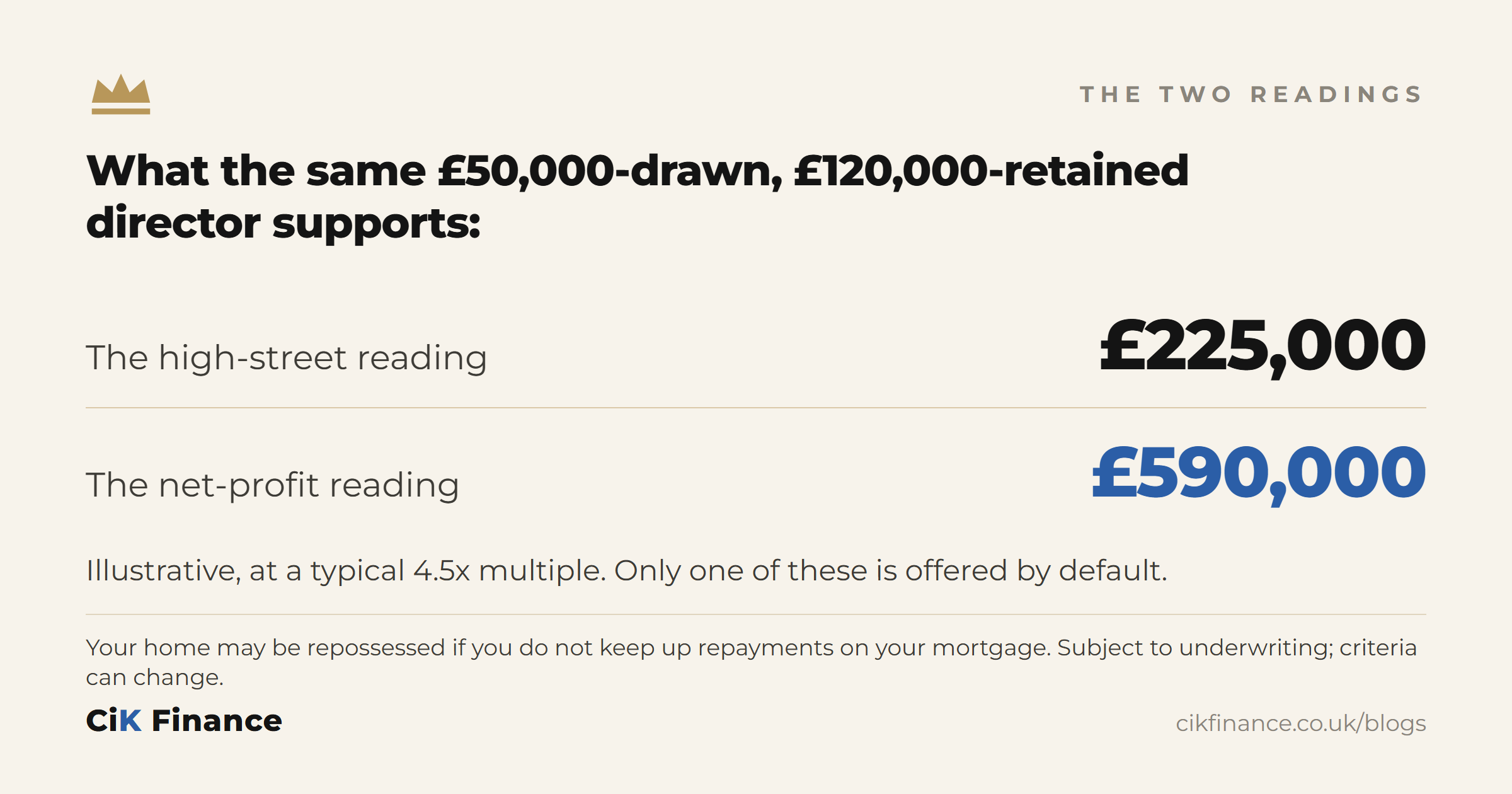
- On an illustrative £50,000 drawn / £120,000 retained structure, the two readings support roughly £225,000 vs £590,000 of borrowing at a typical 4.5 times multiple.
- Most lenders want 2 years of accounts; some can work with 1 full year.
- Your shareholding percentage can change how you're assessed: one building society's criteria, effective 6 August 2026, draw that line at 25%.
- The net-profit assessment is never offered by default; the borrower or their adviser has to ask which lenders can apply it.
Earning more, and running your company more carefully, can make your mortgage smaller. The sentence reads wrong, but the arithmetic is real, and most limited company directors meet it unwarned, usually mid-application.
Here's why it happens, and how much difference the second reading can make.
Why do directors look "smaller" on paper than their business?
Because good tax planning and standard mortgage assessment point in opposite directions.
Your accountant keeps your drawn income lean: a modest salary, dividends up to a sensible band, and the rest of the profit retained in the company. That's textbook planning, and it's usually right.
A standard mortgage assessment then reads exactly two lines: the salary and the dividends. The profit the company kept, often the biggest number in the accounts, never enters the calculation. The more disciplined you've been about leaving money in the business, the smaller you look on the form.
I've been advising for 6 years, and before that I spent more than 10 years working with P&L and business accounts across a range of industries. The single most common moment of disbelief I see is a director discovering that the strongest set of accounts they've ever filed has produced the weakest borrowing figure they've ever been quoted.
What's the difference between the two readings?
A retained profit mortgage isn't a product; it's an assessment method. It means a lender counts your share of the company's net profit after corporation tax as income, instead of only the salary and dividends you drew.
Reading one: salary plus dividends. This is the default at most mainstream lenders. It answers the question "what did this person take out of the company?" It's simple, it's cautious, and for a director who retains profit it can dramatically understate earning power.
Reading two: salary plus net profit. A smaller group of lenders can, in certain cases, assess your salary plus your share of the company's profit after corporation tax, whether or not you drew it. It answers a different question: "what could this person take?" For a profitable company, it's often a much larger number, from the same filed accounts.
Neither reading is wrong. They're different philosophies about whose money the retained profit is. But only one of them is offered to you by default, and no calculator on a comparison site tells you the other exists.
How big is the gap in practice?
Take an illustrative director, rounded numbers throughout. Sole shareholder. Salary of £12,570 (the personal allowance), dividends of £37,430, so £50,000 drawn. The company retains around £120,000 a year after corporation tax.
On reading one, at a typical 4.5 times income, £50,000 supports borrowing in the region of £225,000.
On reading two, the assessable income becomes roughly £132,570, and the same multiple puts the ceiling near £590,000.
Salary plus dividends: £50,000 assessable, around £225,000 of borrowing at 4.5x. Salary plus net profit: around £132,570 assessable, around £590,000 at the same multiple.
Same person. Same company. Same PDF at Companies House. A difference of more than £350,000 in borrowing capacity, decided entirely by which lines of the accounts the lender is willing to read. Multiples and criteria vary by lender and circumstances, so treat these as shapes rather than promises, but the shape is real and we see it month after month.
What happened when "the best year ever" met the standard reading
A scenario we see versions of constantly, told here as a composite.
A director has just filed the company's best year. Revenue up, profit up, corporation tax paid without a wobble. He and his wife have found the house: bigger garden, right school, the one you don't get twice. They need £470,000, and given the year the business has had, he isn't worried.
The decision that comes back isn't a no. In a way it's worse: it's a yes to barely half. The calculator read his £50,000 of drawings, multiplied it, and stopped. The £120,000 the company kept, the money that made it the best year, never entered the sum.
What he did next is the part worth writing down. He asked his accountant whether they'd been doing it all wrong, whether they should have drawn more and paid more tax, purely to look bigger on a mortgage form. Three years of careful planning, and one form had him doubting all of it.
The answer wasn't to unpick the tax planning. It was to change the reader. Assessed on salary plus net profit, the same accounts told the story the business had actually lived, and the £470,000 fitted with room to spare. The structure was never the problem. The reading was.
One composite, drawn from many cases; every real application is assessed on its own facts, and criteria change.
Does your shareholding percentage matter?
Increasingly, yes, and it's worth knowing which side of the line you sit on before you apply.
Lenders draw a threshold, commonly at 20% or 25% of the shares, that decides whether you're assessed as employed or self-employed. Leeds Building Society's updated criteria, effective 6 August 2026, put it plainly: under 25% and you're assessed as employed, on payslips and dividends; 25% or more and you're assessed as self-employed, with the company's net profit information required at decision-in-principle stage.
The same job title, "director", can be read two entirely different ways depending on a percentage. If your shareholding has changed recently, or you sit near the line, the reading of your income can change with it. Thresholds differ between lenders, and criteria change, so check before an application is moving rather than during. Criteria referenced here were checked on 24 August 2026.
Five questions to ask before you apply
1. What does my company retain after corporation tax, per the filed accounts? That's the number the second reading unlocks. If you don't know it, your mortgage research isn't finished.
2. Is the profit trend flat, rising, or lumpy? Lenders that read net profit usually want a stable or rising picture, and most average or take the lower of the last 2 years.
3. How close is my year-end? If the next set of accounts tells a better story and your year-end is a few months away, when you apply can matter as much as where. Filing first can change which numbers get read for the next 2 years.
4. What percentage of the company do I hold? It can decide which assessment route, and which paperwork, applies to you.
5. Has anyone actually run both readings? If the only figure you've seen came from a high-street calculator, you've seen one reading, not the market.
Frequently asked questions
Can I get a mortgage based on retained profits?
Often, yes. A smaller group of lenders can, in certain cases, assess salary plus your share of the company's net profit after corporation tax, which brings retained profit into the calculation. It depends on your shareholding, the profit trend, and the lender's criteria at the time.
Do mortgage lenders use salary and dividends or net profit for directors?
Most use salary plus dividends by default. Some can use salary plus net profit after tax instead, which often produces a substantially higher assessable income for directors who retain profit. Which route applies depends on the lender and your circumstances.
How many years of accounts do I need for a director mortgage?
Most lenders want 2 years of filed accounts. Some can work with 1 full year, and a small number can consider a strong first-year case before the year-end, particularly where the trading continues an established career. The first year generally needs to cover a full 12 months. Contractors working through their own company are often assessed differently again, on the day rate itself rather than the accounts.
Should I pay myself a bigger salary to borrow more?
Usually that's the wrong way round, and it can cost you tax for years to fix a problem a different lender would read away. Before changing how you pay yourself, find out whether a net-profit assessment solves it with the structure you already have. Whether to change your remuneration is a question for your accountant.
Does my shareholding percentage affect my mortgage application?
It can. Many lenders assess directors below a threshold, commonly 20% or 25%, as employed, and at or above it as self-employed, which changes both the income calculation and the paperwork. Thresholds vary by lender and criteria change.
What to do next
If you're a director with profit sitting in the company and a mortgage somewhere on the horizon:
- Dig out the last 2 years' filed accounts and note the net profit after tax.
- Note your year-end date; the timing question is worth asking before any application.
- Before accepting any single quote as the answer, have both readings run against your numbers.
We read the accounts before the call
If the numbers in this article look like yours, send over the last 2 years' accounts and we'll have read them before we speak. Then we'll tell you plainly which reading fits, including "wait until after your year-end" if that's the honest answer.
Related reading: Limited company buy-to-let mortgages: the full comparison · Should I sell my buy-to-let?
About the author. Kieran Ali is a mortgage and protection adviser and the founder of CiK Finance. Six years advising; more than 10 years before that reading P&L and business accounts across multiple industries. CiK Finance specialises in mortgages for company directors, contractors and landlords whose income doesn't fit the high-street box.
Your home may be repossessed if you do not keep up repayments on your mortgage. Figures in this article are illustrative; every application is subject to underwriting, and criteria can change depending on circumstances. CiK Finance is a trading name of CiK Financial Ltd, an appointed representative of PRIMIS Mortgage Network, a trading name of First Complete Limited, which is authorised and regulated by the Financial Conduct Authority. This article does not constitute tax advice; whether and how to change your remuneration is a matter for your accountant.