

Mortgages · 5 minute read
What the April 2027 tax changes mean if you own property or a business
By Kieran Ali · 25 November 2026
One date, several changes
The short version
- 6 April 2027 is the date. Several of the Budget measures start on that one day, so if you own property, a business or both, more than one of them probably touches you.
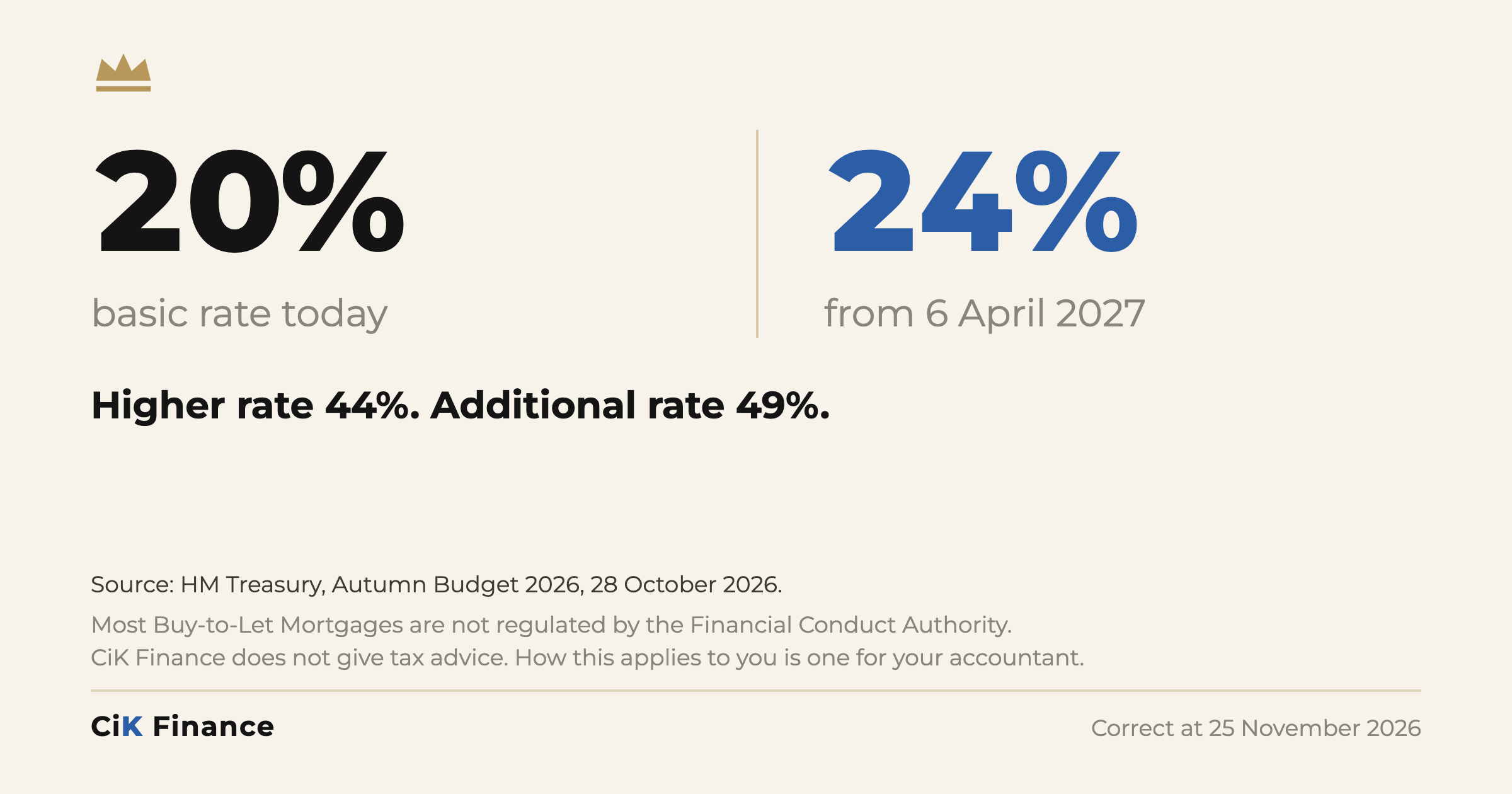
- Tax on rental income rises 2 points. Confirmed: 24% basic, 44% higher, 49% additional, in England, Wales and Northern Ireland.
- The relief rate on finance costs has not been published. For a landlord with borrowing it can move the final number more than the headline rate does, so the arithmetic is worth waiting for.
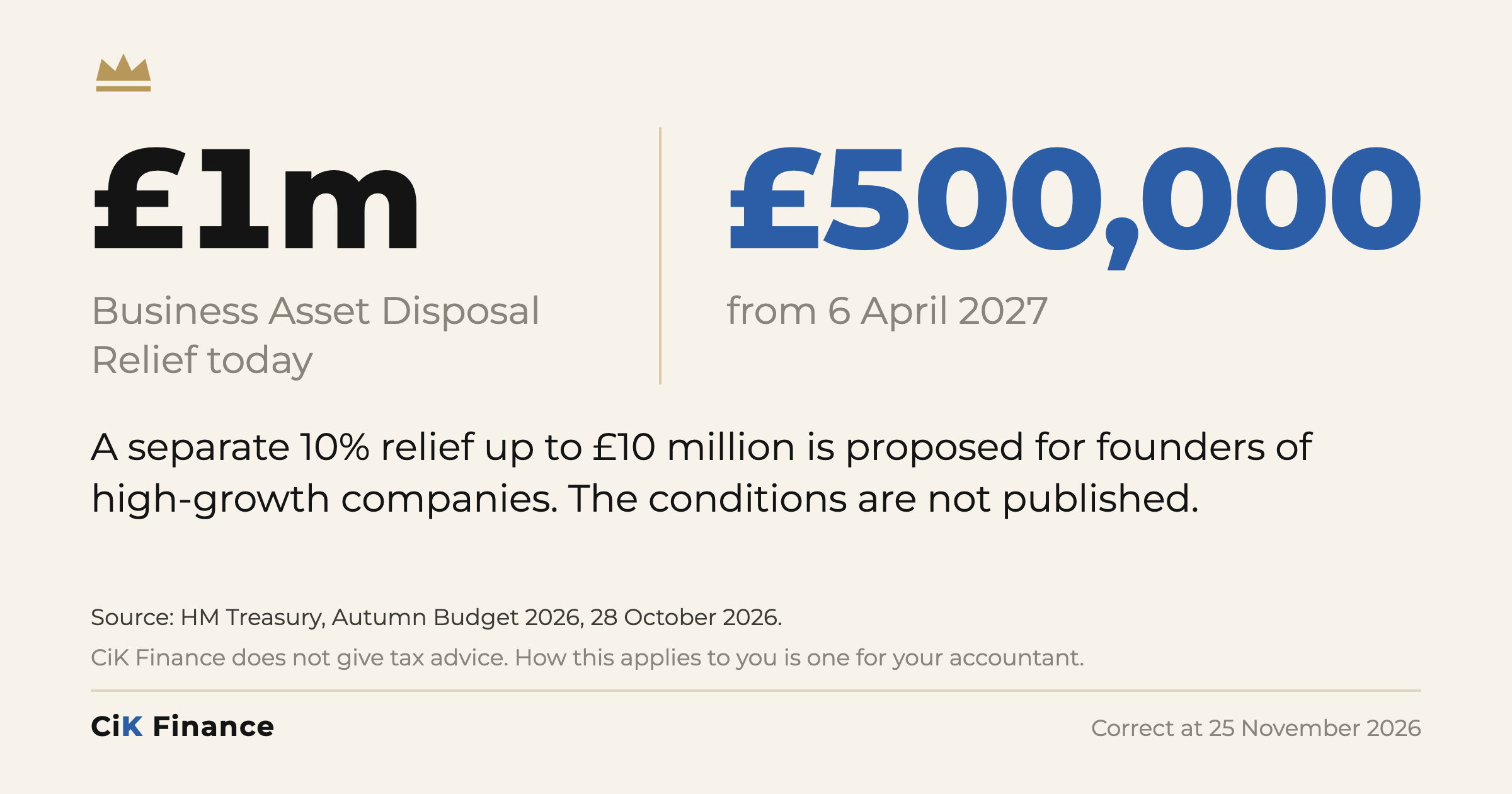
- Business Asset Disposal Relief halves. Confirmed: the lifetime limit falls from £1 million to £500,000.
- Founders' Relief is only proposed. A 10% rate up to £10 million of gains, with the conditions still at consultation, so nobody can say yet who would qualify.
- Most of it is not changing. Income tax rates and thresholds, National Insurance, VAT, corporation tax, stamp duty, the main capital gains rates and dividend tax all stay where they are.
- Everything here comes from the Budget documents published by HM Treasury on 28 October 2026. CiK Finance does not give tax advice.
6 April 2027 is doing a lot of work.
Several of the measures announced in the Autumn Budget on 28 October start on that single day and if you own property, a business or both, more than one of them probably touches you.
This is the plain version. What's confirmed, what's a consultation and what hasn't been published at all. We've labelled each one because a fair amount of what's circulating treats a proposal as though it were already law.
Everything below comes from the Budget documents published by HM Treasury on 28 October 2026.
Tax on rental income goes up 2 points. Confirmed.
If you own property in your own name, you pay income tax on your rental profit.
From 6 April 2027 the property rates become:
24% at the basic rate, 44% at the higher rate and 49% at the additional rate.
These replace the 22%, 42% and 47% property rates that were set at Budget 2025 and never took effect.
What that looks like on a number. A basic-rate landlord with £10,000 of rental profit pays £2,000 today. From 6 April 2027, £2,400. That's £400 a year more, on that example, before anything else is taken into account.
The rates apply in England, Wales and Northern Ireland. The Scottish and Welsh governments are being given the power to set their own property income rates, which starts after talks with them.
The government's own line is that 84% of income tax payers will be unaffected by the savings and property changes taken together.
Relief on finance costs is also moving. Not published.
This is the one to be careful about.
Landlords who own property personally get relief on finance costs, including the interest on the loan used to buy the property. The relief reduces the tax bill at a fixed rate. Budget 2025 set that rate at 22% from April 2027.
The Budget raised property rates by 2 points, and the rate for finance cost relief after that rise has not been published. The documents don't say whether it will be 24%.
We're not going to guess it and we'd be wary of anyone who does. For a landlord with borrowing, this figure can do more to the final number than the headline rate does. It's worth waiting for the confirmed rate before doing arithmetic on a portfolio.
Tax on savings interest goes up 2 points. Confirmed.
Interest earned outside an ISA follows the same pattern. From 6 April 2027 the savings rates become 24%, 44% and 49%, across the whole UK.
The Personal Savings Allowance doesn't change: £1,000 for basic-rate taxpayers, £500 for higher-rate taxpayers. Interest inside an ISA stays tax-free and the overall ISA limit stays at £20,000. The planned cut to the cash ISA limit has been cancelled, so that stays at £20,000 too.
Tax on wages and on self-employed profits isn't affected by this change.
This matters more than it looks for business owners sitting on cash outside a tax wrapper, which is a lot of them.
Selling a business: a cut and a possible offset
Two measures here, and they have to be read together. Taken on its own, the first one is misleading.
Business Asset Disposal Relief halves. Confirmed.
The lifetime limit falls from £1 million to £500,000 from 6 April 2027.
Founders' Relief is proposed. Consultation.
A new relief would apply a 10% rate of capital gains tax to qualifying disposals of shares, up to a lifetime limit of £10 million of gains per person, for sales on or after 6 April 2027. It's aimed at founders of high-growth, innovative companies and significant early investors in them.
Three things about Founders' Relief that get left out:
- The conditions aren't published. A technical consultation asks how the proposed individual, company and growth and innovation conditions would work in practice. Those conditions decide who qualifies, so nobody can tell you today whether you would.
- It's aimed at a small group. High-growth, innovative companies and their early backers, rather than business owners generally.
- The two interact. Using Business Asset Disposal Relief or Investors' Relief from 6 April 2027 reduces that £10 million limit.
So for someone who ends up qualifying, the new relief could more than offset the cut. For someone who doesn't, the cut stands on its own. Both are real outcomes and which one applies to you isn't knowable yet.
The consultation closes on 30 November 2026. If you own a high-growth company and you have a view on how the conditions should work, the deadline is coming up fast.
What isn't changing
Worth as much space as the changes and it gets almost none in the coverage.
- Income tax rates. 20%, 40% and 45% for 2027-28.
- Income tax thresholds. The Personal Allowance stays at £12,570 and the higher rate threshold at £50,270 until 5 April 2031. This freeze was decided at Budget 2025 and is already law. It was not announced on 28 October, whatever you may have read.
- National Insurance rates. Employees 8% and 2%, employers 15%, self-employed 6% and 2%. The Employment Allowance stays at £10,500.
- VAT. No increase to the headline rate.
- Corporation tax. 25% main rate, 19% small profits rate. Full expensing and the £1 million Annual Investment Allowance stay.
- Stamp duty rates for home buyers.
- Capital Gains Tax main rates. 18% and 24%, with the £3,000 yearly tax-free amount.
- Dividend tax. 10.75%, 35.75% and 39.35%, with the £500 dividend allowance.
- Inheritance tax thresholds. The £325,000 nil-rate band and the £175,000 residence nil-rate band stay frozen until 5 April 2031, also decided at Budget 2025.
In other words, most of what a business owner earns and most of what they pay to buy a house is sitting where it was.
What this changes about borrowing
We're mortgage and protection advisers rather than accountants, so this is the part we can speak to directly.
Nothing above changes how a lender assesses you. It does change some of the numbers they'll be reading.
For a landlord, rental profit after tax is what services the borrowing. If the tax on that profit rises and the relief on the interest changes, the figures in a buy-to-let case move and the sensible time to look at that is before a fixed rate ends rather than after.
For a business owner, the decision about how to take income from the company is a tax decision made with an accountant. It's also the decision that sets the figure a lender reads, often a year or more later. Those two conversations almost never happen in the same room and that's where most of the avoidable problems come from.
For anyone thinking about selling a business before or after 6 April 2027, the timing question is an accountant's, not ours. But if a sale is part of how a mortgage gets paid down or a property gets bought, it's worth us knowing about it early.
What I'm watching
Three things, between now and April.
The finance cost relief rate, which is the single most useful missing number for landlords.
The Founders' Relief conditions, which decide whether that relief is real for anyone we speak to.
And how lenders respond to the rental income change in their buy-to-let calculations, which they've had no reason to publish yet.
We'll write again when any of those arrive.
Frequently asked questions
What changes on 6 April 2027 if I own rental property?
Income tax on property income rises by 2 points: 24% at the basic rate, 44% at the higher rate and 49% at the additional rate, in England, Wales and Northern Ireland. That much is confirmed in the Budget documents published by HM Treasury on 28 October 2026. The rate of relief on finance costs that goes with it has not been published, and for a landlord with borrowing that figure can move the final number more than the headline rate does. CiK Finance does not give tax advice. How this applies to you is one for your accountant.
Has the relief on buy-to-let mortgage interest changed?
It still works the same way, reducing the tax bill at a fixed rate rather than coming off the rental profit. Budget 2025 set that rate at 22% from April 2027. The Autumn Budget raised property rates by 2 points and did not publish the finance cost relief rate that sits alongside them, so the figure to use is not yet known. Most Buy-to-Let Mortgages are not regulated by the Financial Conduct Authority.
Is Business Asset Disposal Relief being abolished?
No. The lifetime limit falls from £1 million to £500,000 for disposals from 6 April 2027, which is confirmed. Alongside it the government has proposed a separate Founders' Relief, applying a 10% rate of capital gains tax to qualifying disposals of shares up to a £10 million lifetime limit. The two interact: using Business Asset Disposal Relief or Investors' Relief from 6 April 2027 reduces that £10 million limit.
Would I qualify for Founders' Relief?
Nobody can tell you yet, and that is the honest answer rather than a cautious one. The proposed individual, company and growth and innovation conditions are at technical consultation, which closes on 30 November 2026, and it is those conditions that decide who qualifies. The relief is aimed at founders of high-growth, innovative companies and significant early investors in them rather than at business owners generally.
Does any of this change what I can borrow?
Nothing announced changes how a lender assesses you, but it does change some of the numbers they read. For a landlord it is the rental profit after tax that services the borrowing, so the figures in a buy-to-let case can move. For a business owner, how income is taken from the company is a tax decision made with an accountant and it is also the decision that sets the figure a lender reads, often a year or more later. What it means for your own case depends on your individual circumstances. Your home may be repossessed if you do not keep up repayments on your mortgage.
Next step
If you own property or a business and you'd like to talk through what this means for your borrowing rather than your tax return, get in touch and we'll go through it. No urgency, no obligation.
For the tax side, your accountant is the right call, and this article is a reasonable thing to send them.
Kieran Ali is the founder of CiK Finance and a mortgage and protection adviser based in Daventry, Northamptonshire.
Correct at the time of publication, 25 November 2026. Based on the Budget documents published by HM Treasury on 28 October 2026. Several measures were unpublished or at consultation stage at the time of writing and may change.
CiK Finance does not give tax advice. How any of this applies to you is one for your accountant.
Most Buy-to-Let Mortgages are not regulated by the Financial Conduct Authority.
Your home may be repossessed if you do not keep up repayments on your mortgage.
CiK Finance is a trading name of CiK Financial Ltd. We are an appointed representative of First Complete Limited, which is authorised and regulated by the Financial Conduct Authority.