

Mortgages · 5 minute read
Remortgaging in 2027: what to do and when, if your fixed rate is ending
By Kieran Ali · 11 November 2026
The date only one side of it is watching
The short version
- A lot of fixed rates end in 2027. Your lender knows the date. Most people would have to go and find it.
- 6 months out is where the work sits. Early enough to change what a lender is reading, not just compare what is on offer.
- Doing nothing has a default outcome. For most mortgages the rate reverts to the lender's standard variable rate on the day.
- Product transfer or remortgage. One lender's range and a lighter process, or a wider set of lenders and more paperwork.
- Loan-to-value bands commonly sit at 60%, 75%, 80%, 85% and 90%. Crossing into the band below can change the whole list of rates you can see.
- If your income is self-employed, which year is filed when can matter more than the rate you pick.
Most people couldn't tell you the day their fixed rate ends. They could find it, given the paperwork and 10 minutes but it isn't a date they carry around in their head.
The lender carries it around though. It's in their system and when it arrives they move the mortgage onto their standard variable rate because that's what the contract says happens. No letter needed on the day, no conversation, no decision from you.
So the deadline exists. It's just that only one side of it is keeping track.
A lot of fixed rates end in 2027. If yours is one of them, this is what's worth doing and roughly when.
What actually happens when a fix ends
Nothing dramatic and that's part of the problem.
Your fixed period finishes. The rate reverts to the lender's standard variable rate, which is set by them and can move. For most people that's a higher payment than the fixed rate they were on and often higher than the rate they could have arranged instead.
Nobody stops you. The direct debit changes and life carries on. We've seen people sit on a reverted rate for the better part of a year, not because they decided to but because nothing forced the question.
The useful thing to understand is that you're not choosing between your fixed rate and the standard variable rate. You're choosing between the standard variable rate and whatever you can arrange before it starts.
The timeline
These aren't rules. They're where there's still room to change the answer.
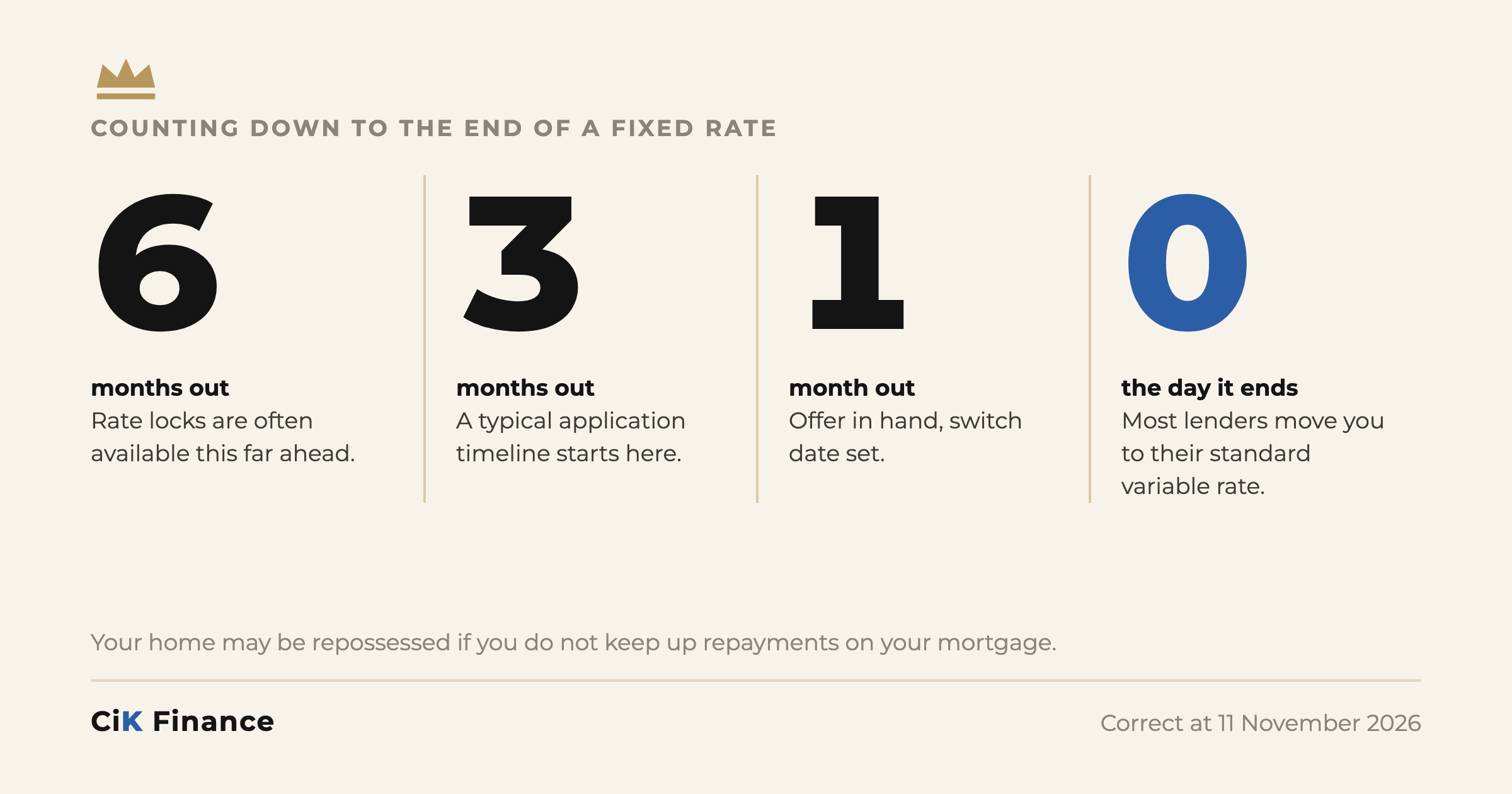
6 months out.
This is where the real work sits. Most lenders will let a new rate be secured several months ahead of the switch date and it can usually be changed if something better appears before then, so there's rarely a penalty for being early. More importantly, 6 months is enough time to change the inputs rather than just shop the outputs. That means filing accounts, paying down a balance, tidying a credit file, sorting out anything on a statement that will need explaining.
3 months out.
A typical application timeline starts comfortably here. Documents gathered, a view taken on which route fits, the application in with time for the inevitable extra question. Valuations and legal work on a remortgage take as long as they take and nobody can compress them much.
1 month out.
You want an offer in hand and a switch date set. Still doable but you're now choosing from what's in front of you rather than improving your position.
The day it ends.
Most lenders move you to their standard variable rate. If nothing is in place, that's the outcome by default.
Product transfer or remortgage
Two different routes, often confused and the difference matters.
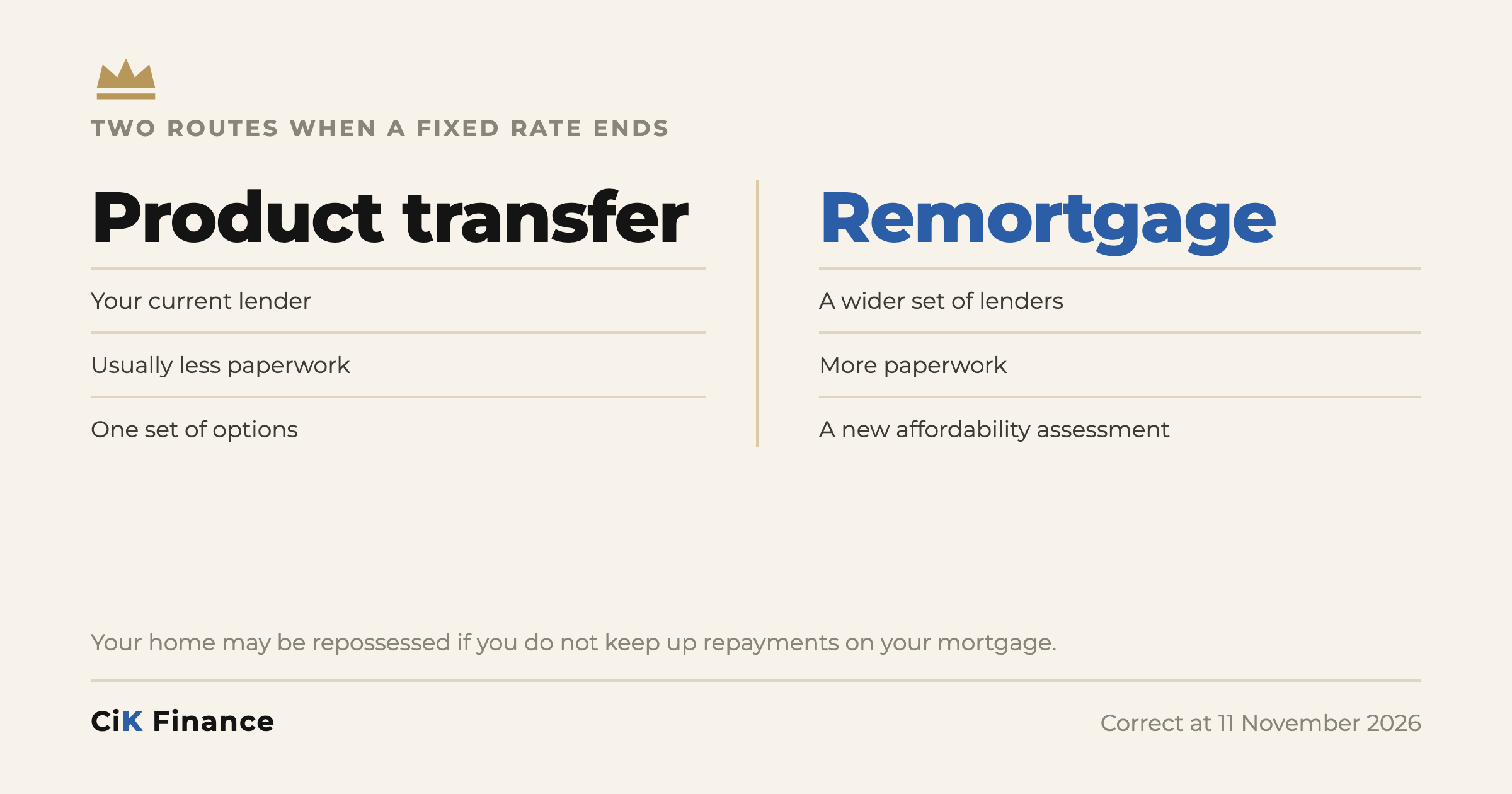
A product transfer means taking a new rate with your existing lender. It's usually the lighter process: less paperwork, frequently no new valuation and in many cases no fresh affordability assessment because you're not borrowing more from someone new. The trade-off is that you see one lender's range.
A remortgage means moving to a different lender. More paperwork, legal work, a valuation and a new assessment of your income and outgoings. In return you get a wider set of lenders to choose from, which matters most when your circumstances have changed or when your income is the kind that some lenders read better than others.
Neither is automatically right. What usually decides it:
- Has your income changed shape since the last application? If it has, the wider set is worth the extra work.
- Do you want to borrow more, change the term or take someone off the mortgage? That's generally a remortgage conversation.
- Is speed the constraint? A transfer is normally quicker.
- Is the balance close to a loan-to-value band? More on that below.
We're appointed representatives of PRIMIS Mortgage Network and we look across a wide set of lenders rather than across all of them. Part of what we do is tell you when your own lender's offer is the sensible answer, which happens more often than people think.
What changes if your income is self-employed
We deal with this a lot. The mechanics of a remortgage don't change but the timing does.
A lender reads what's been declared and filed. For a director that's usually salary and dividends drawn, not what the company made and kept. Which means the single most powerful thing you can do is often administrative rather than financial: file the year that supports the application, before you apply.
The kind of case that crosses our desk regularly looks like this. Somebody decides in the autumn that next year is the year they remortgage and borrow a bit more. The year that's filed is the weaker of the two. The stronger year isn't filed yet and won't be until the spring. With 6 months of runway that's a sequencing question. With 6 weeks it's a smaller mortgage. (Illustrative: a pattern rather than one named client.)
Also worth knowing: some lenders can, in certain cases, assess salary plus a share of net profit rather than just what was drawn. That can move the figure a long way for a director who has been leaving profit in the company. It's a policy difference between lenders rather than a rule, which is exactly why the wider set of lenders helps us here.
The loan-to-value point nobody mentions
Rates are usually banded by how much you're borrowing against the value of the property. Common bands sit at 60%, 75%, 80%, 85% and 90%.
Inside a band, paying a bit off the balance does very little. Crossing into the next band down can change the whole list of rates available to you.
So before you apply, it's worth working out where you actually sit. If you're at 76% and a few thousand pounds would take you under 75%, that's a calculation worth doing properly. If you're at 68%, paying more off won't change which rates you can see and the money may be better somewhere else.
This is also why a valuation matters. If the property is worth more than you think, you may already be in a better band than you assumed.
What I'd do, in order
- Find the date your fixed rate ends. Actually find it and write it somewhere you'll see it.
- Count back 6 months. Put that in the diary too.
- Work out your loan-to-value on a realistic valuation.
- If your income is self-employed, ask your accountant which year will be filed when and whether the stronger year can be in before you apply.
- Then look at rates. Not before.
Most of that list is free and none of it needs a decision today.
Frequently asked questions
When should I start looking at remortgaging before my fixed rate ends?
About 6 months out. Most lenders will let a new rate be secured several months ahead of the switch date, and it can usually be changed if something better appears before then. Six months is also long enough to change what a lender is reading, rather than only comparing what is on offer.
What happens if I do nothing when my fixed rate ends?
For most mortgages the rate reverts to the lender's standard variable rate, which the lender sets and can move. Nothing stops it happening: the direct debit changes and the mortgage carries on. Your home may be repossessed if you do not keep up repayments on your mortgage.
Is a product transfer better than a remortgage?
Neither is automatically right. A product transfer with your existing lender is usually the lighter process and shows you one lender's range. A remortgage to a different lender means more paperwork, legal work and a new assessment, and gives you a wider set of lenders to choose from, which matters most when your circumstances have changed. Which one fits depends on your individual circumstances.
Does being self-employed change the timing of a remortgage?
The mechanics do not change but the sequencing does. A lender reads what has been declared and filed, so for many directors the most useful step is administrative: making sure the year that supports the application is filed before applying. Some lenders can, in certain cases, assess salary plus a share of net profit rather than only what was drawn, which is a policy difference between lenders rather than a rule.
Does paying a lump sum off before I remortgage help?
It depends where you sit. Rates are usually banded by loan-to-value, commonly at 60%, 75%, 80%, 85% and 90%. Inside a band, paying a bit off does very little. Crossing into the band below can change the list of rates available to you, so the calculation is worth doing properly before you apply.
Where we come in
If your fixed rate ends in 2027 and you'd like a second pair of eyes on the timing, get in touch and we'll go through it. No urgency and no obligation, and if the answer is that your own lender's product transfer is the right move, we'll tell you that.
If you'd rather not think about it yet, use Track My Deal. It takes about 60 seconds, there are no documents and no credit search and it'll remind you when the date gets close.
The door is open either way.
Kieran Ali is the founder of CiK Finance and a mortgage and protection adviser based in Daventry, Northamptonshire.
Correct at the time of publication, 11 November 2026. Lender criteria and rates change, and nothing here is a recommendation that any particular mortgage is suitable for you.
Your home may be repossessed if you do not keep up repayments on your mortgage.
CiK Finance is a trading name of CiK Financial Ltd. We are an appointed representative of First Complete Limited, which is authorised and regulated by the Financial Conduct Authority.